
In November last year, I published an article called “Only Nine Months Left of BI 4.3”. At the time, it felt slightly provocative. Some people nodded. Some parked it for later.
Well — it’s now 1 February 2026, and that “later” arrived quietly, without ceremony. The Silly Season came and went, projects paused, calendars reset — and suddenly we’re staring at the same deadline, just much closer than it felt a few months ago.
If you’re still running a production SAP BusinessObjects 4.3 environment, you now have 11 months until 31 December 2026, when BI 4.3 reaches the end of mainstream maintenance (as confirmed in SAP Note 3349500).
But as I said in the original article — and this is the part that matters — December is not your real deadline.


Time Flies: The BI 4.3 Clock Is Officially Ticking (Update — 1 February 2026)
"The deadline didn’t move.....Your margin for delay did"
About the Author
Hi, I'm Clint and I've been knee-deep in the SAP Business Objects world for over 25 years now. Yeah, I know, longer than I care to admit. My first installation was way back in SAP BI 6.5 - back when Desktop Intelligence was still a thing. Needless to say, I've seen it all.
After running two wildly successful global SAP Analytics consulting firms, being a SAP Mentor, and speaking on all things SAP Analytics and SAP Business Objects around the world, I'm here to help. I've moved to the "employee of one" model, and I'm available worldwide to assist you with your SAP BO upgrade.
I get it - I know how SAP is moving towards a "cloud first" approach, just like every other big vendor out there. But I also know that customers need to keep their on-premise BI 4.x implementation running alongside SAP Analytics Cloud (SAC), as there's no seamless migration path to SAC. With all the lower versions of Business Objects, except for BI 4.3 and BI 2025, now being out of support, the need to upgrade for many customers is pressing. So, feel free to connect with me below to start the conversation or connect with me here or you can find out more about me here.


“With over 25 years in SAP Analytics, I’ve guided numerous businesses through seamless upgrades, ensuring minimal downtime and optimal performance.”
Why December 2026 Is a False Sense of Safety
On paper, December 2026 looks generous, but projects don’t move on paper — they move through people, procurement cycles, infrastructure provisioning, approvals, testing windows, and release calendars.
In the first article, I laid out a reality most teams underestimate: you still need three to four months for the technical migration itself, additional time for testing, remediation, and cutover, and you will lose weeks to business freeze periods you don’t control.
That maths hasn’t changed. What has changed is how much slack you have left. Once you factor in year-end change freezes, reduced staff availability, and the need for post-go-live stability, your last realistic go-live window is October 2026.
That leaves February to October 2026 — nine months on paper, but in practice, far less once you account for how organisations actually operate.
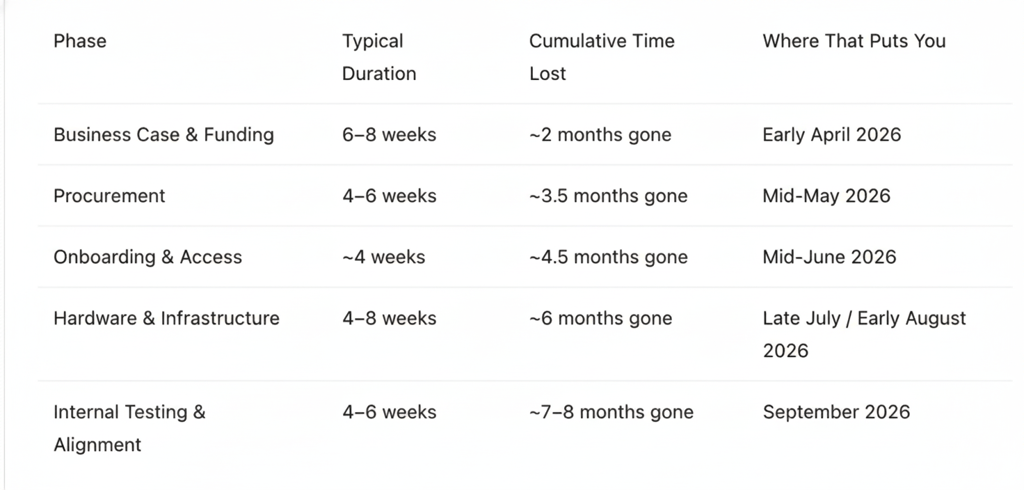
Revisiting the Time Thieves (With Real Dates)
One of the key points in the original Nine Months Left article was that BI upgrades rarely fail because of technology — they fail because time disappears long before the technical work even starts.
Let’s revisit that timeline, but this time anchor it to where we are now.
By the time you’ve simply cleared the runway — funding approved, contracts signed, access granted, infrastructure ready — you are already deep into Q3.
This is exactly what I flagged in the original Only Nine Months Left of BI 4.3 article. Back then, I made the point that a realistic BI migration needs at least three to four months for:
The actual migration work
Parallel testing
User acceptance testing (UAT)
Cutover and post-go-live stabilisation
That assumption hasn’t changed.
What has changed is the calendar.
Once you subtract the unavoidable lead time above, that original nine-month window collapses into four to five months of real execution time.
That’s why I keep repeating this point: your effective delivery window is far closer to four or five months, not nine.
Hemisphere Reality Check: Time Is Not Evenly Distributed
This is the part many global organisations miss. Your calendar disadvantage depends heavily on where you operate.
Northern Hemisphere: Summer Is a Hard Stop
For most Northern Hemisphere organisations, the June–August period is effectively reduced capacity:
Key staff on extended leave
Change freezes around peak vacation periods
Lower risk tolerance for major platform changes
In practice, July and August are often lost months.
That means if you’re planning to "get serious after mid-year," you’re already compressing your timeline dramatically. What looks like 6–7 months on paper is closer to 4–5 months of usable delivery time.
Southern Hemisphere: The 30 June Financial Year Trap
Southern Hemisphere customers face a different but equally dangerous constraint.
Many organisations operate on a 30 June financial year, which introduces two problems:
If BI 2025 needs to be delivered this financial year, you’re already late
Budget approvals, funding resets, and resource allocations often pause or reset around EOFY
Projects that slip past June frequently don’t regain momentum until August or September, by which point the window is razor-thin.
Why End of October Is the Real Line in the Sand
In both hemispheres, the conclusion is the same.
If you want a controlled, supportable, low-risk transition, the latest sensible go-live window is the end of October 2026.
After that:
November is consumed by stabilisation avoidance
December is functionally unusable due to holidays and freezes
Any issues discovered late are carried straight into end-of-support territory
An October go-live gives you:
Time to stabilise before year-end
A buffer for unexpected issues
Breathing room before maintenance officially ends
December is not a target. October is the deadline that actually protects you.
The Point of This Article
This isn’t a new warning. It’s an update.
The clock didn’t suddenly start ticking — it’s been ticking the whole time. What changed is how much margin you’ve burned without realising it.If you want to dig deeper, I’ve written a few related articles worth revisiting:
Upgrading to SAP BI 2025: What Features You’re Losing and Keeping
The End of SAP BI Analysis for Office — What You Need to Know
SAP BI 2025 Is Live — How Does This Affect Your Existing Environment?
Only Nine Months Left of BI 4.3 (And Yes, This Title May Be Clickbait)
Each one builds toward the same conclusion.
If BI 4.3 is still running production workloads in your landscape, the safest time to be live on BI 2025 is behind you — the second safest time is now.
The deadline didn’t move.
Your margin for delay did.
Final Thought
Yes, technically SAP BusinessObjects 4.3 has time left on the calendar. But projects don’t run on calendars — they run on availability, approvals, funding cycles, hardware lead times, testing windows, and human bandwidth.
When you factor all of that in, December 2026 stops being a deadline and starts being a trap. In practical terms, you have about nine months left to move with confidence, not panic.
If you want a second set of eyes on your upgrade roadmap or a reality check on your timeline, reach out. A short scoping conversation now is far cheaper than a rushed decision later.
Here’s how we can work together:
Assess Your Current Environment
Understand your existing setup and challenges.


Develop an Upgrade Strategy
Tailored to your business needs and timelines.
Execute and Support
Implement the upgrade with ongoing support to ensure success.





My SAP Analytics Blog

Connect with me today to ensure your SAP BI 2025 Upgrade is a success !
Alternatively please send an email to sapupgrades@clintvosloo.com