
Every week I speak to customers who are aware that SAP BusinessObjects BI 4.3 hits end of mainstream maintenance on 31 December 2026. Most of them nod when I mention it. Some have even read the SAP documentation. And some of them have made a conscious decision to stay put — at least for now.
As of today — 1 July 2026 — we are officially in the second half of the year. Six months left. The countdown is no longer abstract.
I understand the reasoning for staying put. Customer-Specific Maintenance sounds reassuring on paper. SAP keeps the lights on. You can still log support cases. The system keeps running. No immediate crisis.
But there is a significant gap between what Customer-Specific Maintenance sounds like and what it actually means when something goes wrong in your production environment at 2am on a Monday.
This article is about closing that gap — using SAP's own words.
The document I'm referring to throughout is SAP Knowledge Base Article 3486924 — Customer-Specific Maintenance Phase for SAP BusinessObjects Business Intelligence, Version 8, released 13 May 2026. This is the current, official SAP position on what happens after mainstream maintenance ends. I'd encourage every customer sitting on BI 4.3 to read it in full.
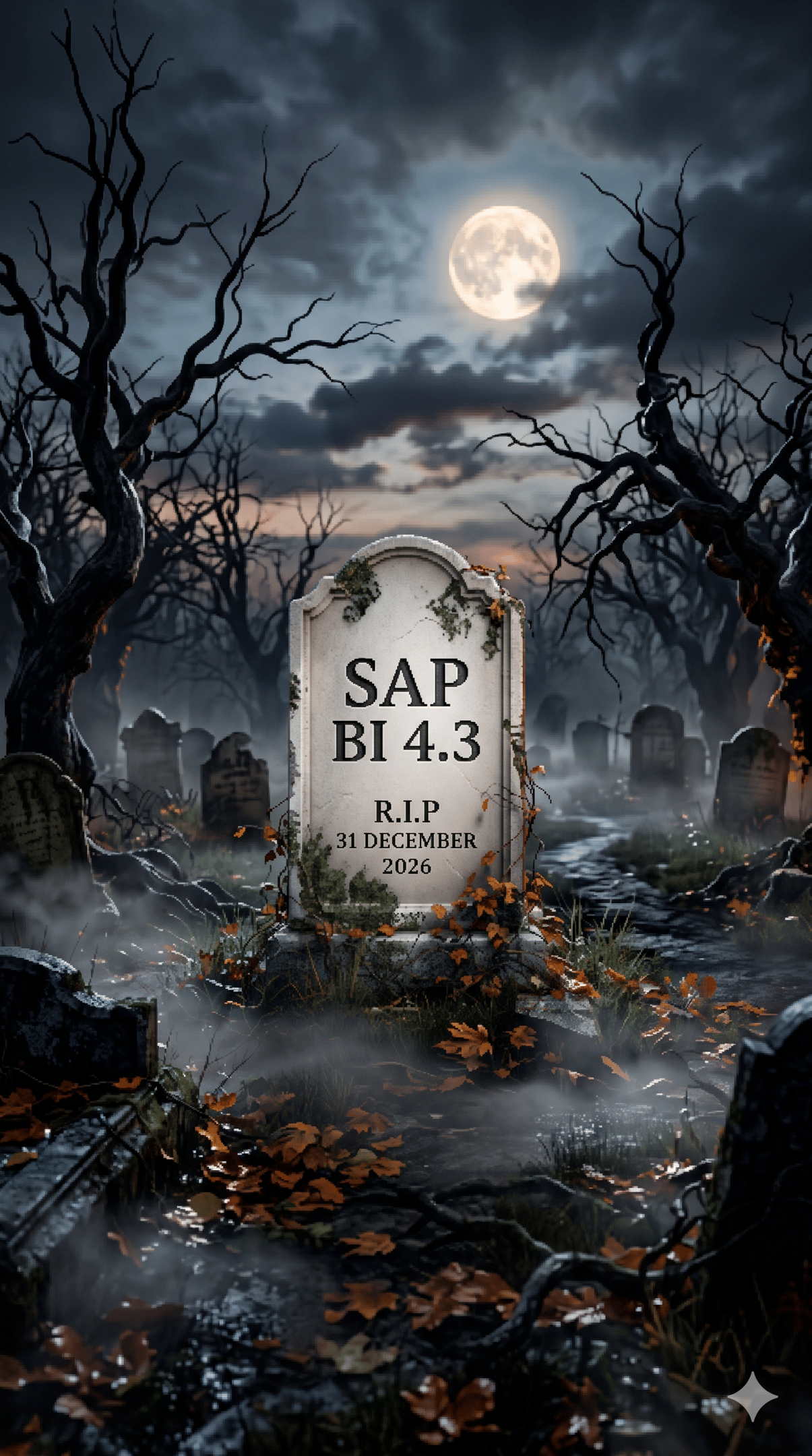
Staying on BI 4.3 After December 2026 — Here's What You're Actually Signing Up For
"SAP has told you exactly what happens after December 2026. Most people just haven't read it."
About the Author
Hi, I'm Clint and I've been knee-deep in the SAP Business Objects world for over 25 years now. Yeah, I know, longer than I care to admit. My first installation was way back in SAP BI 6.5 - back when Desktop Intelligence was still a thing. Needless to say, I've seen it all.
After running two wildly successful global SAP Analytics consulting firms, being a SAP Mentor, and speaking on all things SAP Analytics and SAP Business Objects around the world, I'm here to help. I've moved to the "employee of one" model, and I'm available worldwide to assist you with your SAP BO upgrade.
I get it - I know how SAP is moving towards a "cloud first" approach, just like every other big vendor out there. But I also know that customers need to keep their on-premise BI 4.x implementation running alongside SAP Analytics Cloud (SAC), as there's no seamless migration path to SAC. With all the lower versions of Business Objects, except for BI 4.3 and BI 2025, now being out of support, the need to upgrade for many customers is pressing. So, feel free to connect with me below to start the conversation or connect with me here or you can find out more about me here.


“With over 25 years in SAP Analytics, I’ve guided numerous businesses through seamless upgrades, ensuring minimal downtime and optimal performance.”
What Customer-Specific Maintenance Actually Is
SAP Note 3486924 defines it clearly:
"Customer-Specific Maintenance is the phase of maintenance that starts after the completion of Mainstream Maintenance."
It's worth understanding what this phase replaced. For older BI versions — 4.2 and earlier — what followed mainstream maintenance was called Priority One Support, which at least guaranteed SAP would fix production-stopping issues. That model is gone. From BI 4.3 onwards, the phase that follows mainstream maintenance is Customer-Specific Maintenance, and the rules are materially different.
For those who want to go deeper, SAP Note 3486924 cross-references several related documents worth reading: SAP Note 52505 (support after end of mainstream maintenance), SAP Note 3053725 (security corrections in CSM), KBA 2078591 (Priority-One maintenance for BI 4.2 and earlier), and KBA 1550818 (where to find archived service packs and patches). Together they give you the full picture of what the post-mainstream landscape actually looks like.
What You Get: The First 12 Months
The first year of Customer-Specific Maintenance (CSM) is the best it's going to be. SAP Note 3486924 confirms that during this period:
"Development will deliver security fixes during the first 12 months of CSM for VH and H security issues (CVSS >= 7.0) impacting BI."
So for the twelve months following 31 December 2026 — meaning through to the end of 2027 — you will receive security patches, but only for vulnerabilities rated CVSS 7.0 or above. Medium-severity vulnerabilities, low-severity vulnerabilities, and anything that isn't a security issue gets nothing.
For BI 4.3, those security fixes land on top of SP05 — the final support pack. For BI 2025, patches are delivered cumulatively with no support pack structure.
And after those 12 months?
"No new software delivery (SP, Patch, Hot fix, Private Note) will happen after the first 12 months."
That's it. After December 2027, if you're still on BI 4.3, there are no more software deliveries of any kind. Whatever state the software is in at that point is the state it stays in — permanently.
What Happens When Something Breaks
This is the section most customers haven't read carefully enough. SAP Note 3486924 is explicit about how support cases are handled in CSM:
"Customers can continue to create messages as usual. The reported error is analyzed. If the software error is already known, an SAP Note will be shared as a solution. If the error is not known yet, further processing is regarded as a consulting service subject to charge."
Read that again slowly.
If SAP has already documented the problem — you get the known solution. Fine.
If the problem is new — one they haven't seen before — SAP will charge you to investigate it. You are no longer paying maintenance for SAP to fix bugs. You are paying maintenance to receive solutions to problems SAP already knew about. New problems are billable consulting engagements.
The Note goes further:
"SAP cannot guarantee that every problem can or will be solved within Customer-Specific Maintenance."
That sentence is written by SAP's legal team, not their marketing team. It means exactly what it says. If you have a production issue on BI 4.3 after December 2026, SAP is telling you in writing that they may not fix it.
The OS and Database Problem — And It's a Serious One
Here's the part that connects directly to the infrastructure conversation I've been having with customers, and it's buried in the Note in a way that's easy to miss:
"SAP cannot support software from third-party providers (for example, operating systems, databases or components), which is no longer maintained by the manufacturer. Therefore, you may have to carry out an upgrade to more current versions of this software. However, more recent versions of the software may not be supported for releases in Customer-Specific Maintenance. In this case, it is your responsibility to decide whether you want to carry out an upgrade or continue using the old version of the software that is no longer supported."
Let me translate that, because it's dense.
If your OS or database goes out of support from its manufacturer, SAP won't support it either. But — and this is the critical part — if you upgrade your OS or database to a newer version, SAP may not support that on a release in Customer-Specific Maintenance. You can be stuck in either direction.
A significant number of customers are running BI 4.3 on Windows Server 2016. Microsoft's Extended Support for Windows Server 2016 ends January 2027 — the same month BI 4.3 enters Customer-Specific Maintenance.
That's a double cliff on the same date. BI 4.3 loses mainstream maintenance. Windows Server 2016 goes fully end of life. And the SAP Note tells you that SAP cannot support an OS that is no longer maintained by its manufacturer.
If something goes wrong on that stack in early 2027, you have a BI platform in CSM, running on an OS with no manufacturer support, and SAP's own Note says they can't help with third-party software that's out of support. You are on your own.
The Test Environment Is Gone
This one doesn't make the headlines but it should. SAP Note 3486924 contains this line:
"Restrictions are in place due to SAP removing the internal system landscapes at the start of the Customer-Specific Maintenance of that release. As a result, it may only be possible to analyse the error directly in the customer system. For the analysis, the customer has to make a remote access available."
SAP decommissions their internal BI 4.3 test environment on 1 January 2027. From that point, if you log a support case and SAP needs to reproduce the issue, they cannot do it in their own environment. They need remote access to your production system.
Think about what that means in practice. You have a production incident. You log it with SAP. SAP's response is to ask for remote access to your live environment because they no longer have a BI 4.3 test system. Your security team has views on that. Your change management process has views on that. And the clock is ticking.
You Can't Easily Install or Upgrade Either
The Note also confirms something that catches customers completely off guard when they eventually decide to move:
"Please note that we do not support installations or upgrades to target releases that are in Customer-Specific Maintenance. If you require the installation software, for example, when you migrate a database or an operating system, create an SAP customer message under the component XX-SER-SWFL-SHIP. Depending on the release, the provision of the installation software may require some processing time."
If you need to migrate your database or OS while BI 4.3 is in CSM — which, as I've just explained, many customers will need to do — the standard installation and upgrade software is no longer visible in the Software Download Center. You have to raise a special request with SAP. It takes time. It introduces delays into what is already a pressured situation.
The Timeline, Stated Plainly
SAP Note 3486924 confirms the following dates:
BI 4.3:
Mainstream Maintenance ends: 31 December 2026
Customer-Specific Maintenance starts: 1 January 2027
Security fixes (CVSS ≥ 7.0) delivered through: December 2027
After December 2027: no software deliveries of any kind
BI 2025:
Mainstream Maintenance ends: 31 December 2027
Customer-Specific Maintenance starts: 1 January 2028
So What Does "Staying on BI 4.3" Actually Mean?
It means this, stated plainly:
From 1 January 2027, if you're still on BI 4.3:
You receive security patches only, for critical vulnerabilities only, for 12 months
New bugs are billable consulting engagements, not maintenance obligations
SAP cannot guarantee resolution of any problem
SAP has no internal test environment for your version
Your OS support situation may leave you exposed on multiple layers simultaneously
After December 2027, no software of any kind is delivered
And the Note reminds you, in black and white:
"SAP cannot guarantee that every problem can or will be solved within Customer-Specific maintenance."
That's not a legal footnote. That's the product's actual support position.
The Two Scenarios I'm Seeing Right Now
Scenario 1: BI 4.3 on Windows Server 2016
Both the BI platform and the OS hit their respective walls in January 2027. No BI mainstream maintenance. No OS manufacturer support. SAP Note 3486924 explicitly states SAP cannot support third-party software that is no longer maintained. This is the highest-risk position in the market right now, and there are more customers here than most people realise.
Scenario 2: BI 4.3 on Windows Server 2022
BI 4.3 enters CSM in January 2027. Windows Server 2022 loses mainstream support in October 2026 — before BI 4.3 even hits its wall. So you arrive at CSM already running on an OS in Extended Support. You're not in the double-cliff position, but you're not in a clean one either.
The right position: BI 2025 on Windows Server 2025
Full mainstream maintenance on both layers. BI 2025 through December 2027. Windows Server 2025 through October 2029. Clean PAM alignment. No grey zones. No exposure.
My Recommendation
If you are still on BI 4.3 and the upgrade conversation hasn't started — start it now. Not because of a deadline on a calendar, but because of what the support position actually looks like from 1 January 2027.
The decision to stay on BI 4.3 after December 2026 is not a neutral decision. It is an active choice to operate a production BI platform with no guaranteed bug fixes, no OS-level third-party support from SAP, no internal SAP test environment, and a support model where new problems are your financial responsibility to resolve.
If you're planning the move to BI 2025, I'd also recommend reading what functionality SAP removed in BI 2025 before you start — and why the infrastructure decisions you make during that upgrade determine how painful BI 2027 will be. The upgrade is manageable. But it pays to go in with eyes open.
When you read SAP Note 3486924 in full — and I'd encourage you to do exactly that — the picture is considerably less comfortable than "Customer-Specific Maintenance" sounds.
If you want to work through what the upgrade path looks like for your specific environment, reach out. The conversation is free. The cost of finding out what CSM actually means during a production incident is not.
Here’s how we can work together:
Assess Your Current Environment
Understand your existing setup and challenges.


Develop an Upgrade Strategy
Tailored to your business needs and timelines.
Execute and Support
Implement the upgrade with ongoing support to ensure success.

My SAP Analytics Blog

Connect with me today to ensure your SAP BI 2025 Upgrade is a success !
Alternatively please send an email to sapupgrades@clintvosloo.com